
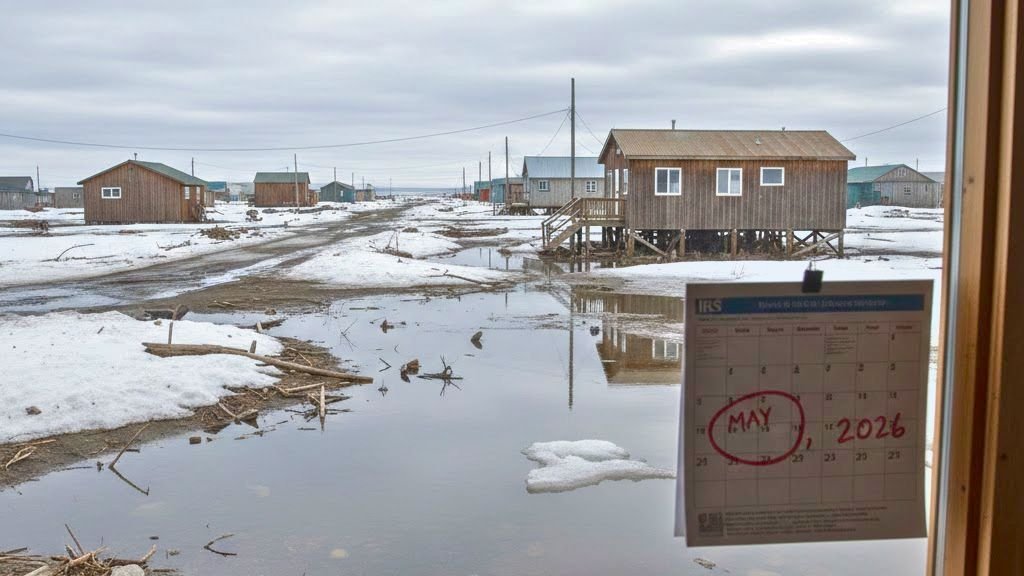
The Internal Revenue Service (IRS) has shared an important update for individuals and businesses in parts of Alaska affected by severe storms, flooding, and the remnants of Typhoon Halong. This information is taken directly from the IRS website and is shared here for general awareness and understanding.
According to the IRS, tax relief is now available for taxpayers in specific areas of Alaska where the disaster began on October 8, 2025. The relief gives extra time to file certain tax returns and make tax payments, with many deadlines extended to May 1, 2026.
Table of Contents
Areas Covered by This Relief
The relief applies to taxpayers who live or have a business in the following Alaska regions:
- Lower Kuskokwim Regional Educational Attendance Area
- Lower Yukon Regional Educational Attendance Area
- Northwest Arctic Borough
These locations are officially treated as a covered disaster area after a federal disaster declaration was issued.
Who Can Get This Extra Time
The IRS considers the following groups as eligible for this relief:
- Individuals who live in the covered disaster areas
- Businesses and tax-exempt organizations whose main office is in these areas
- Taxpayers outside the area whose important tax records are located in the disaster zone
- Relief workers helping in the affected areas
- Individuals who were injured or lost their lives while visiting the disaster area
If you fall into one of these groups, the IRS may allow more time for certain tax-related actions.
New Deadline: May 1, 2026
For affected taxpayers, many tax deadlines that normally fall between October 8, 2025, and May 1, 2026, are now moved to May 1, 2026. This includes:
- Individual income tax returns and payments
- Business tax returns
- Partnership and S corporation returns
- Estate and trust tax returns
- Certain employment and excise tax returns
Estimated tax payments that were originally due in January and April 2026 are also included in this extension.
Retirement and Health Contributions
Eligible taxpayers in the disaster areas also have until May 1, 2026, to make contributions to:
- Individual Retirement Accounts (IRAs)
- Health Savings Accounts (HSAs)
These contributions will still count for the 2025 tax year if made by the extended deadline.
Payroll and Excise Tax Relief
For payroll and excise tax deposits due between October 8, 2025, and May 1, 2026, penalties may be removed if the required deposits are made by May 1, 2026. Quarterly payroll and certain excise tax returns due in early 2026 are also covered under this relief.
Penalty Notices and What to Do
Some taxpayers may still receive late filing or late payment notices. If the original due date on the notice falls within the relief period, the IRS advises calling the phone number listed on the notice. The IRS can review the case and remove the penalty if the taxpayer qualifies for disaster relief.
Automatic Relief and Special Cases
The IRS automatically applies this relief to taxpayers whose address is on record within the covered disaster area. However, if you qualify but live outside the area, you may need to call the IRS Special Services number at 866-562-5227 to request assistance.
Tax professionals who hold records for multiple clients affected by the disaster can also contact the IRS for guidance.
Important Note on Information Returns
The IRS has clarified that this deadline extension does not apply to certain information returns, including many forms in the 1099 series, W-2 forms, and some other reporting forms. Filing and payment rules for these forms remain unchanged unless stated otherwise by the IRS.
Conclusion:
This update is shared to help taxpayers stay informed during a difficult time. For accurate filing and timely submission of applicable forms, Form1099Online.com remains an IRS-authorized e-filing platform that supports secure and compliant Form 1099 filing. For official rules and eligibility, taxpayers are encouraged to review the full guidance published by the Internal Revenue Service.