
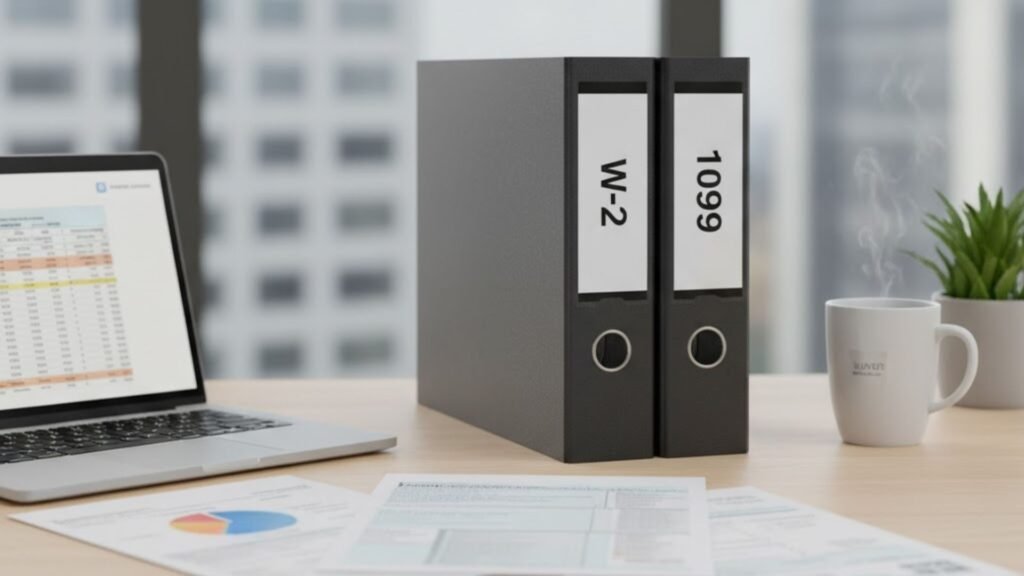
Companies usually deal with both workers and contractors. Nevertheless, their classification and reporting to IRS is quite different. In 2026, there will also be a couple of updates that will alter the way companies release Forms W-2 and 1099. These are the basic tips to get you to see these fundamental differences and what they entail to your business.
Table of Contents
Worker Classification
The key distinction between the Form W-2 and Form 1099 is reduced to the type of the worker.
- Form W-2: This one is designed with employees. Employers determine when, where and how the employees work. They also deal with the tax withholdings such as federal income tax, Social security and Medicare.
- Form 1099-MISC or 1099-NEC: They are applied to independent contractors. The contractors determine the way they will finish their work and are paid the end product. They manage their taxes and they do not have to be controlled and supervised by their employers.
Concisely, a worker is an employee in case the process and work hours are guided by a business. In case the worker dictates his own means, he is a contractor.
Withholding and Reporting of Tax.
Another significant difference is in the manner in which taxes are handled.
- W-2: There are a number of taxes that employers are required to pay on behalf of employees. These are federal income tax, social security, Medicare and unemployment insurance. Employees are issued with a W-2 statement at the end of the year that does indicate the amount of earnings that the employee has earned and taxes that the employee has not been subjected to.
- 1099-MISC/NEC: In the case of contractors, there are no taxes collected. The contractor gets the entire payment of his/her work and pays federal, state and self-employment tax. The company files 1099 form in case the payments are above the reporting threshold.
This necessitates proper classification to prevent error in tax season.
2026-Specific Updates
Beginning with payment disbursed beyond December 31, 2025, both 1099 and W-2 forms have essential changes.
For 1099-MISC/NEC:
The reporting threshold raises to 2000 dollars in 2026. Companies are no longer required to issue a form when they pay a contractor over 2000 in a given year. Another limit that will also be adjusted to inflation will be this new limit starting in 2027.
For W-2:
The 2026 code has added three Box 12 codes:
- TA – Employer Payments to Trump Account.
- TP – Total Qualified Tips
- TT – Total Qualified Overtime
Employers would need to begin recording their tips and overtime in a detailed manner so as to be able to report accurately.
Employment allowances and Legal Insurance.
- W-2 Employees: Personnel are allowed to enjoy perquisites such as health insurance, vacation leave, and pension. Minimal wage, overtime, and the workers compensation are also other labor laws that protect them. There are some benefits which are mandated by law based on the company size and state regulations.
- 1099 Contractors: The company does not provide benefits to the contractors. The employment laws covering minimum wage and overtime do not apply to them and this is because the employees cover their insurance and pension schemes.
Work Organization and Management.
- W-2: Employees tend to have long term or permanent employment. They use onsite company schedule, and tools, and usually work at the company.
- 1099: Contractors are usually engaged in short term projects or side jobs. They determine their own working hours, sometimes they work at home and they have their own equipment.
This makes it flexible and the reason why most professionals choose to work on contract and businesses seek contractors to meet a given requirement.
Legal Dangers of Mis-classification.
Categorizing a worker as a wrong person may cause severe IRS consequences. When an employer treats a worker as a contractor to pay no payroll taxes, he or she may be liable to repaying the deducted taxes, interests, and penalties. Since the new change of 2026 threshold, the IRS might closely interpret the contractor payments and therefore, proper classification is more significant than ever before.
Conclusion
Knowing when to file out W-2 or 1099 is not a mere paperwork process but an impact on taxes, benefits, and legal obligations.
When you are in doubt about the form you should use, then you are on the safer side to go through IRS guidelines or a tax professional. To e-file easier and secure, 1099 go to Form1099Online.com.
–a government-sanctioned software that assists companies in remaining in compliance with the law and submitting forms appropriately annually.