
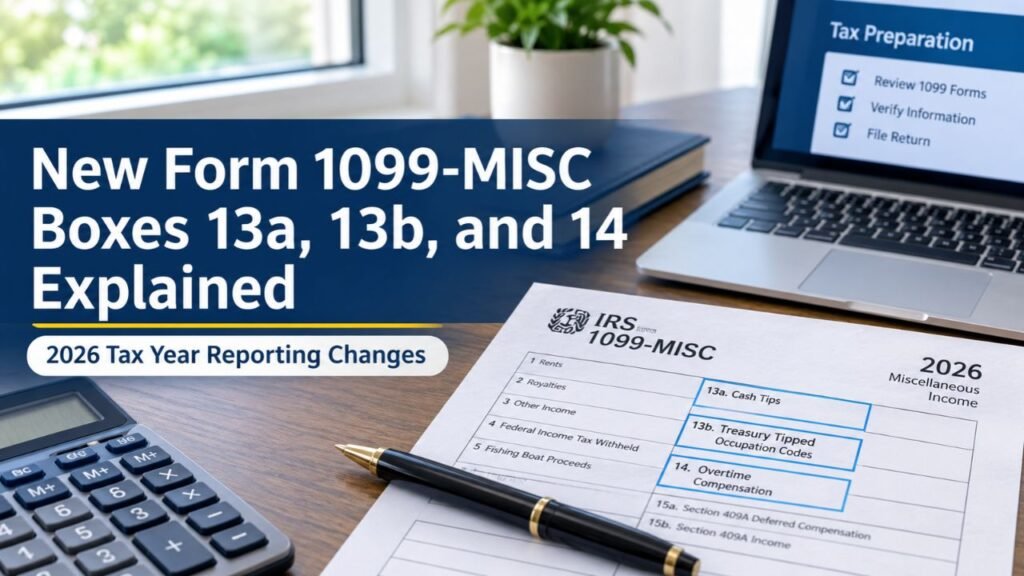
Starting with the 2026 tax year, the IRS has added three new boxes to Form 1099-MISC: Box 13a (Cash Tips), Box 13b (Treasury Tipped Occupation Codes), and Box 14 (Overtime Compensation). These reporting changes were introduced under the One Big Beautiful Bill Act (OBBBA) to support federal income tax deductions for qualified tips and overtime compensation.
Businesses filing Form 1099-MISC in 2027 must complete these boxes when the corresponding reporting requirements apply to payments made during 2026. This article explains what to enter in each new box, how these amounts relate to Box 3, and how to report them when filing Form 1099-MISC online.
Table of Contents
What Are the New Boxes on Form 1099-MISC for 2026?
According to the IRS Instructions for Forms 1099-MISC and 1099-NEC, the following reporting fields apply beginning with the 2026 tax year.
| Box Number | Box Name | Reporting Requirement |
|---|---|---|
| Box 13a | Cash Tips | Cash tips included in Box 3 |
| Box 13b | Treasury Tipped Occupation Code(s) | Up to two tipped occupation codes |
| Box 14 | Overtime Compensation | Qualified overtime compensation included in Box 3 |
Amounts reported in Boxes 13a and 14 are already included in Box 3 (Other Income). They are not additional payments. Box 13b identifies the occupations in which the recipient earned tips.
Form 1099-MISC Box 13a: Cash Tips
Box 13a reports the cash tip portion of the income entered in Box 3 of Form 1099-MISC. For reporting purposes, cash tips include tips paid in physical cash and tips charged by customers using payment cards.
What to Enter in Box 13a
Enter the total cash tips already reported in Box 3. Do not include mandatory service charges as voluntary tips.
Example of Box 13a Reporting
Suppose a business makes the following payments that are reportable in Box 3:
| Payment Description | Amount |
|---|---|
| Other income excluding tips | $5,000 |
| Cash tips | $1,500 |
| Total income | $6,500 |
Enter the amounts on Form 1099-MISC as follows:
| Form 1099-MISC Box | Amount |
|---|---|
| Box 3 – Other Income | $6,500 |
| Box 13a – Cash Tips | $1,500 |
The total income is $6,500, not $8,000. Box 13a separately identifies the tip income included in Box 3. Recipients use the amount reported in Box 13a to determine their eligible qualified tips deduction on Schedule 1-A (Form 1040).
Form 1099-MISC Box 13b: Treasury Tipped Occupation Code (TTOC)
Box 13b identifies the occupation in which the recipient earned cash tips. A Treasury Tipped Occupation Code (TTOC) is a three-digit code assigned to an occupation that customarily and regularly received tips on or before December 31, 2024.
The IRS provides an official Treasury Tipped Occupation Code list for reporting these occupations.
How to Complete Box 13b
The IRS allows payers to enter up to two occupation codes in Box 13b.
| Recipient’s Occupations | What to Enter in Box 13b |
|---|---|
| One qualifying occupation | The applicable occupation code |
| Two qualifying occupations | Both occupation codes |
| Three or more qualifying occupations | Any two applicable occupation codes |
| Nonqualifying occupation only | 000 |
| Qualifying and nonqualifying occupations | 000 and one applicable qualifying occupation code |
Select the code based on the recipient’s tipped occupation rather than the payer’s business industry.
What Does Code 000 Mean in Box 13b?
Code 000 indicates that the recipient earned some or all of their reported tips in an occupation that does not qualify for the federal qualified tips deduction.
If a recipient earns tips in both qualifying and nonqualifying occupations, code 000 must be reported as one of the two occupation codes. The presence of code 000 does not automatically disqualify tips earned in a qualifying occupation. Box 13b does not contain a dollar amount. It only reports occupation codes.
Form 1099-MISC Box 14: Overtime Compensation
Box 14 reports qualified overtime compensation already included in Box 3 of Form 1099-MISC. Qualified overtime compensation is the additional payment above a worker’s regular pay rate required under Section 7 of the Fair Labor Standards Act (FLSA). For overtime paid at one and a half times the regular hourly rate, only the additional half-time portion generally qualifies.
What to Enter in Box 14
Report only the qualifying overtime premium, not the entire overtime payment.
Example of Box 14 Reporting
Consider the following overtime calculation:
| Payment Details | Amount |
|---|---|
| Regular hourly rate | $20 |
| Overtime hourly rate | $30 |
| Additional overtime premium per hour | $10 |
| Overtime hours | 10 |
| Total overtime payment | $300 |
| Qualified overtime compensation | $100 |
In this example, the qualified overtime compensation is $100. If the payment is properly reportable in Box 3 of Form 1099-MISC, enter $100 in Box 14 rather than the full $300.
Recipients use this information to calculate their qualified overtime deduction on Schedule 1-A (Form 1040). Employee overtime generally belongs on Form W-2. Ordinary independent contractor service payments generally belong on Form 1099-NEC. Paying a contractor for additional hours does not automatically qualify as FLSA overtime compensation.
How Do Boxes 13a, 13b, and 14 Relate to Box 3?
Box 3 reports the total other income. Boxes 13a and 14 separately identify cash tips and qualified overtime within that total. Box 13b identifies the tipped occupations.
The following example shows how these fields work together, assuming all payments are properly reportable in Box 3.
| Box Number | Payment Description | Reported Value |
|---|---|---|
| Box 3 | Total other income | $10,000 |
| Box 13a | Cash tips | $2,000 |
| Box 13b | Tipped occupation code | Applicable code |
| Box 14 | Qualified overtime compensation | $500 |
The total income remains $10,000, not $12,500. Do not add the amounts in Boxes 13a and 14 to Box 3 again when preparing Form 1099-MISC.
Why Did the IRS Add These New Form 1099-MISC Boxes?
The One Big Beautiful Bill Act introduced federal income tax deductions for qualified tips and overtime compensation for tax years 2025 through 2028.
The new reporting boxes provide recipients with information needed to calculate these deductions.
| Deduction | Maximum Annual Deduction |
|---|---|
| Qualified tips | $25,000 |
| Qualified overtime – Single filer | $12,500 |
| Qualified overtime – Married filing jointly | $25,000 |
These deductions are subject to income limits and other eligibility requirements. Payers report the required payment information on Form 1099-MISC. Recipients determine their deduction eligibility when filing their individual income tax returns.
Other Form 1099-MISC Changes for the 2026 Tax Year
Increased Reporting Threshold
Beginning with payments made in 2026, the reporting threshold has increased from $600 to $2,000 for several payment categories.
| Payment Category | Box | 2026 Reporting Threshold |
|---|---|---|
| Rents | 1 | $2,000 |
| Royalties | 2 | $10 |
| Other income | 3 | $2,000 |
| Medical and healthcare payments | 6 | $2,000 |
| Substitute payments | 8 | $10 |
| Crop insurance proceeds | 9 | $2,000 |
| Gross proceeds paid to attorneys | 10 | $600 |
The $2,000 threshold also applies to certain payments subject to backup withholding. If federal income tax was withheld under backup withholding rules, Form 1099-MISC must generally be filed regardless of the payment amount.
FATCA Filing Requirement Checkbox
Previously, Box 13 contained the Foreign Account Tax Compliance Act (FATCA) filing requirement checkbox. On the revised Form 1099-MISC, the FATCA checkbox remains available without a box number. Boxes 13a and 13b now report cash tips and tipped occupation codes.
How to Report Boxes 13a, 13b, and 14 on Form1099Online.com
When preparing your 2026 Form 1099-MISC on Form1099Online.com, follow these reporting steps:
- Log in to your Form1099Online.com account.
- Select Form 1099-MISC and the 2026 tax year.
- Enter the payer and recipient information.
- Enter the total other income in Box 3.
- Enter the cash tip amount in Box 13a, if applicable.
- Enter the applicable tipped occupation codes in Box 13b.
- Enter qualified overtime compensation in Box 14, if applicable.
- Review the payment amounts and recipient information before submitting the form electronically.
Leave nonapplicable reporting fields blank. Verify that the amounts entered in Boxes 13a and 14 are already included in Box 3. Businesses preparing information returns electronically can also review how the 1099 e-filing process works before submitting their forms.
Form 1099-MISC Filing Deadlines for the 2026 Tax Year
Businesses reporting payments made during 2026 should follow these federal filing deadlines in 2027.
| Filing Requirement | Due Date |
|---|---|
| Furnish recipient copies (generally) | February 1, 2027 |
| Furnish recipient copies for Boxes 8 or 10 | February 16, 2027 |
| Paper filing with the IRS | March 1, 2027 |
| Electronic filing with the IRS | March 31, 2027 |
Businesses required to file 10 or more information returns in aggregate must generally file electronically under the IRS 1099 e-filing requirements.
Payers preparing multiple types of information returns can review the complete Form 1099 filing deadlines for the 2026 tax year to plan their submissions.
The federal filing deadlines, weekend and holiday adjustments, and electronic filing threshold are based on the official IRS General Instructions for Certain Information Returns and Form 1099-MISC filing instructions.
Conclusion
For the 2026 tax year, Form 1099-MISC includes three new reporting fields: Box 13a for cash tips, Box 13b for tipped occupation codes, and Box 14 for qualified overtime compensation.
When preparing Form 1099-MISC, include reportable cash tips and qualified overtime in Box 3 and separately identify those amounts in their corresponding boxes. Use the official IRS occupation code list when completing Box 13b. Businesses and tax professionals can prepare and e-file Form 1099-MISC through Form1099Online.com, an IRS-authorized 1099 e-filing provider.
Disclaimer: This article is intended for general informational purposes and does not constitute tax or legal advice. The box descriptions, occupation code requirements, overtime calculation, and revised reporting thresholds have been cross-checked against official IRS instructions. Reporting requirements may vary depending on individual circumstances and subsequent IRS updates. Payers should consult the latest IRS guidance or a qualified tax professional when necessary.